The Great Denial of Thought: Why Germany is Overlooking the Cognitive Transformation and How Companies Must Act Now.
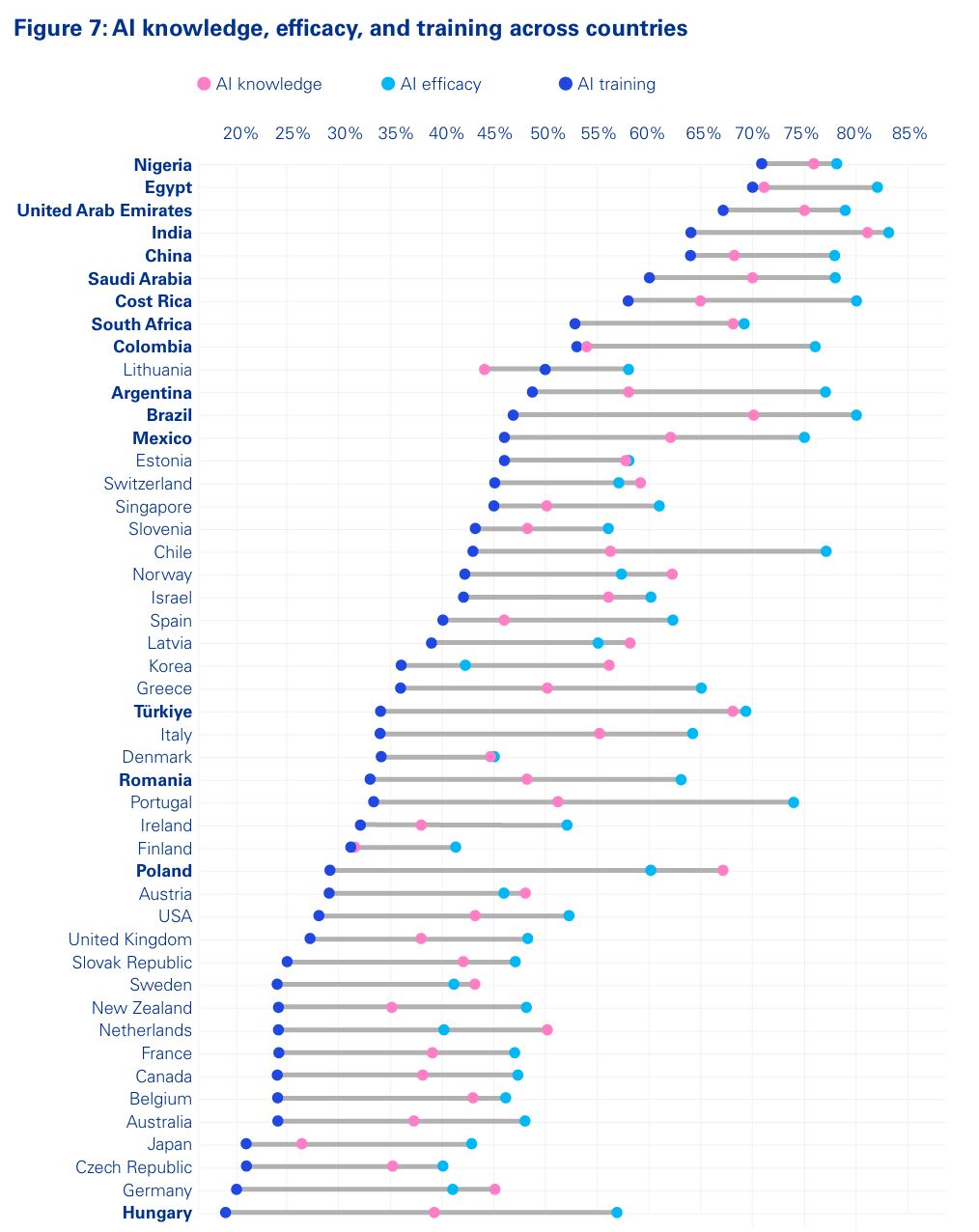
The cognitive transformation is upon us; silent yet irreversible. With the advent of artificial intelligence, not only is the nature of our work changing, but also how we must think to stay relevant. However, while countries globally invest in digital competence, a new comparative study shows (see comment): 𝐆𝐞𝐫𝐦𝐚𝐧𝐲 𝐢𝐬 𝐚𝐦𝐨𝐧𝐠 𝐭𝐡𝐞 𝐥𝐚𝐠𝐠𝐚𝐫𝐝𝐬 𝐢𝐧 𝐀𝐈 𝐤𝐧𝐨𝐰𝐥𝐞𝐝𝐠𝐞, 𝐚𝐩𝐩𝐥𝐢𝐜𝐚𝐭𝐢𝐨𝐧 𝐜𝐨𝐦𝐩𝐞𝐭𝐞𝐧𝐜𝐲, 𝐚𝐧𝐝 𝐭𝐫𝐚𝐢𝐧𝐢𝐧𝐠. A dismal record; not only technologically, but primarily psychologically.
For the true challenge of the AI era is not the operation of new tools, but the development of mental flexibility, cognitive self-regulation, and open-minded thinking architectures. It is about the ability to work with uncertainty, reconstruct meanings, and critically assess machine-generated content. The age of AI demands not more factual knowledge, but mental navigational ability. Yet Germany clings to exam logic, narrow-mindedness, and standardized educational bureaucracy—squandering its future in the process.
The view of the data is alarming: Germany ranks second to last in AI knowledge, application, and training, behind countries like Saudi Arabia, Colombia, or Nigeria. This is not a sign of lacking resources, but of mental inertia. While new thinking models are being tested globally, interdisciplinary learning formats established, and cognitive skills systematically trained, a mindset of complacency is cemented domestically: "We've always done it this way" replaces the courage for reimagining.
Especially tragic: The opportunities are there. Germany has brilliant minds, a critical thinking culture, and innovative talents, but a system that systematically underutilizes all of these. Schools remain content-centric instead of thought-centric, universities test reproduction instead of reflection, the working world rewards conformity instead of cognitive pioneering. Those who wish to use AI meaningfully do not need to program, but rather learn to deprogram their own thinking—from old habits, linear thinking, belief in authority.
In a world where machines simulate thinking, human thinking becomes the most precious resource. This is where companies must intervene: move away from cognitive implosion and towards harnessing inner resources.
My conclusion: Germany is woefully unprepared for cognitive transformation; not because it lacks technology, but because it fails to conceptualize change. 𝐂𝐨𝐦𝐩𝐚𝐧𝐢𝐞𝐬 𝐦𝐮𝐬𝐭 𝐧𝐨𝐰 𝐚𝐝𝐝𝐫𝐞𝐬𝐬 𝐭𝐡𝐞𝐬𝐞 𝐢𝐬𝐬𝐮𝐞𝐬 - I am happy to assist in this.
More on this in a personal dialogue; feel free to write to me.
Next Post