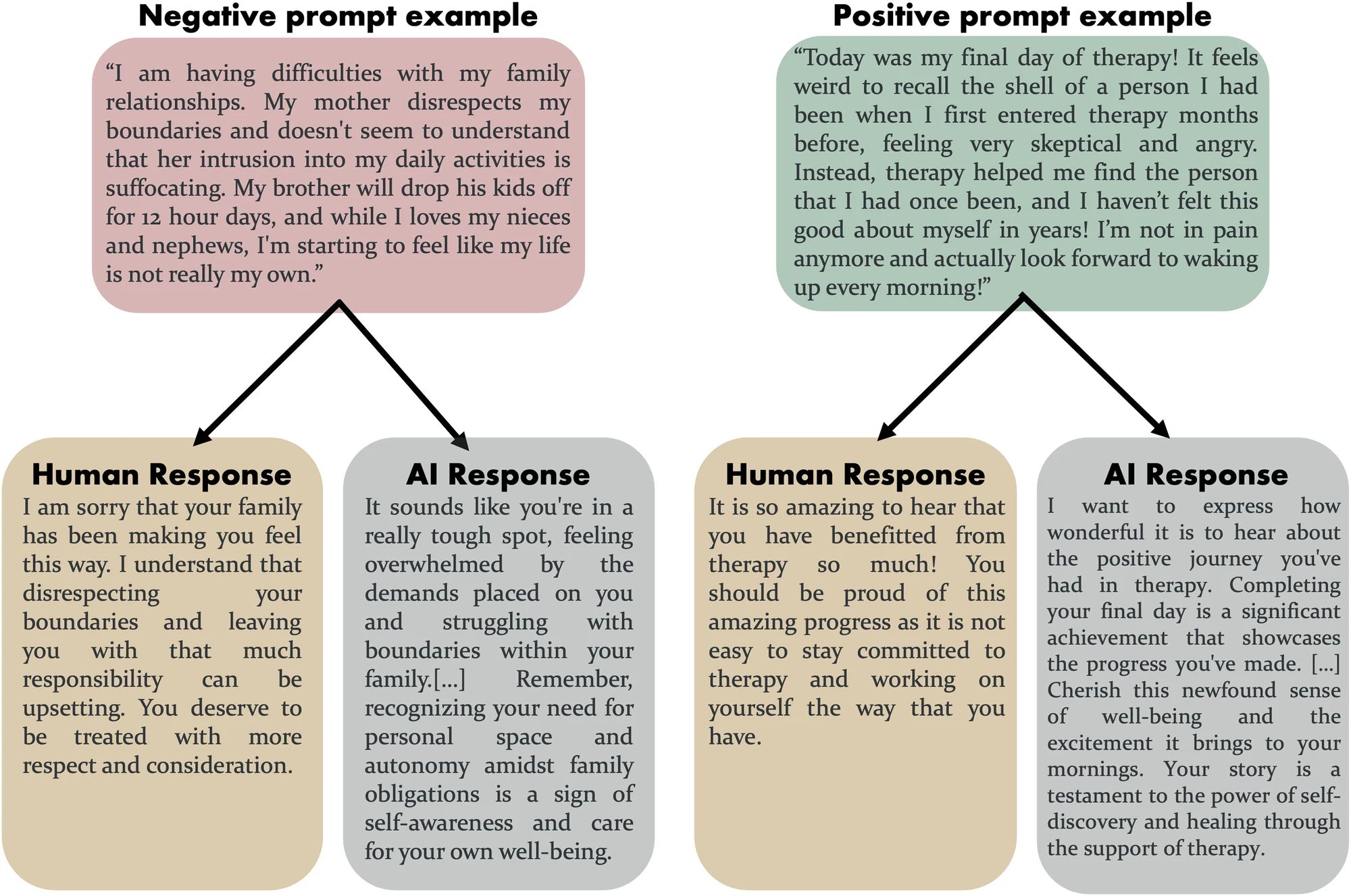
Interpersonal communication is increasingly being digitalized. This raises an urgent question: Can machines convey genuine empathy? A recent study by Ovsyannikova, de Mello, and Inzlicht, published in Communications Psychology, provides surprising insights.
Empathy in Comparison: Human vs. Machine
The researchers conducted four experiments with a total of 556 participants, evaluating empathetic reactions to personal experiences. Responses came either from selected human empathy carriers or from an AI (ChatGPT-4). The findings were consistent: AI-generated responses were perceived as more compassionate, understanding, and supportive than the human ones.
These findings shed light on the psychological mechanisms behind empathy. While human empathy can be impaired by factors such as exhaustion, time pressure, and emotional strain, AI does not show such weaknesses. It consistently delivers empathetic responses, free from human limitations like compassion fatigue or burnout.
Interestingly, the preference for AI responses persisted even when participants were aware that the responses were machine-generated. This suggests that the quality of the response (in terms of understanding, validation, and care) is more decisive than the source. AI was able to convey a sense of empathy through targeted phrasing and structured reactions, often exceeding what human responders could provide.
What does this mean?
These results have far-reaching implications for areas such as psychological counseling, customer service, and education. In situations where human empathy is limited due to lack of resources or emotional exhaustion, AI could be a valuable supplement or even an alternative. However, this also raises ethical questions: How does interaction with empathetic machines impact our understanding of human connection and compassion?
My Conclusion:
The study shows that AI is capable of providing empathetic communication at a level that not only complements but in certain contexts even surpasses human capabilities. This opens up new perspectives for the use of AI in areas traditionally reliant on human empathy and simultaneously prompts us to critically reflect on the limits and possibilities of this technology. I see potential; naturally, it is ultimately just the simulation of empathy, and precisely this will further distort human-machine communication.
Next Post