Devaluation - How AI Disassembles the Concept of Work and Why the Current Crisis is Psychological in Nature
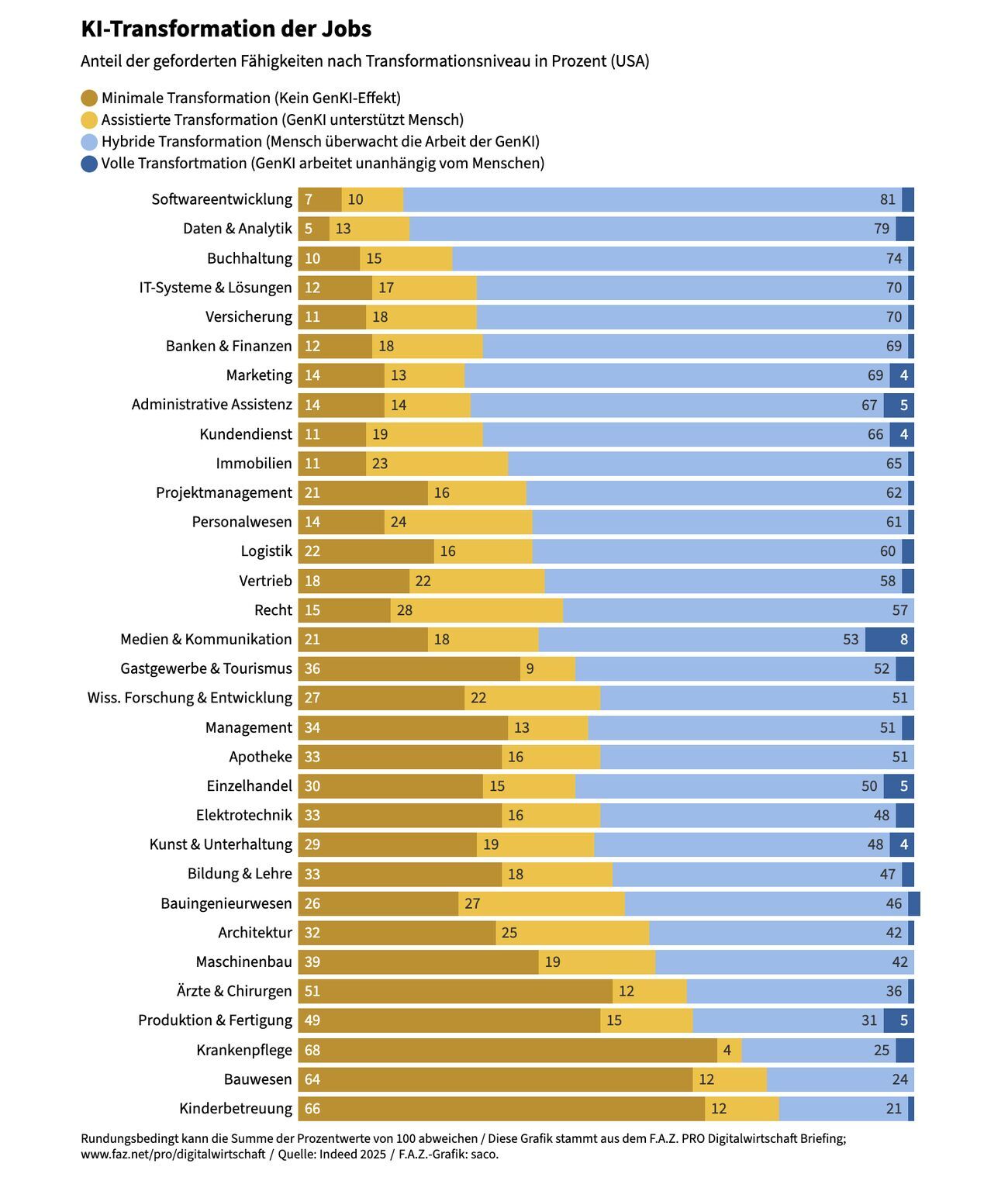
A few days ago, Prof. Holger Schmidt shared a captivating study with new figures on the impact of AI on job segments.
As I delved into it, it became apparent that the focus was not truly on the statistics. Rather, it is about psychology.
To me, the study reveals a tectonic shift in the collective self-perception of work. 81 percent of skills in software development are poised to be fully AI-transformable. In care work, only 4 percent.
This may sound like technology, but it's truly about psychology. For what is crumbling here is not the profession, but the self-worth that was intrinsically tied to it.
Our identity is crafted through function: 'I am what I do.' Yet if what one does can soon be performed more efficiently by machines, the pressing question arises: Who am I then? The result is a gradual psychological erosion. Individuals whose activities are highly automatable experience a loss of meaning. There emerges a new form of cognitive dissonance: between the sense of competence and replaceability. The higher the AI involvement, the greater the identity crisis.
Interestingly, this isn't confined to traditional knowledge work. Even creative, communicative, and managerial roles (long thought irreplaceable) are slipping into the realm of hybrid or assisted transformation. Human beings become overseers of machines. Supervision replaces creation. This breeds a paradoxical form of alienation: One remains part of the process, yet is no longer its core.
The psychological consequence is a reimagined hierarchy of importance. Care, education, and craftsmanship suddenly gain emotional significance because they embody human resonance—something algorithms cannot replicate. Meanwhile, highly-skilled knowledge workers lose their aura. They become interfaces; controlling, delegating, facilitating.
Thus, our understanding of work itself evolves: from a space of self-realization to a realm of system integration. Meaning is no longer derived from performance, but from the capacity to oversee, interpret, and adjust machines. This is no liberation, but a subtle form of psychological decentering.
This is the true transformation: not technological, but existential. We are witnessing the transition from a working society to an observing society, where humans act less but watch more as machines operate. The future of work will be determined not by AI, but by the extent to which individuals can preserve their psychological self-worth in the new system.
The greatest peril of the AI revolution is not unemployment, but insignificance. If individuals do not redefine themselves, the ensuing crisis will not be economic, but psychological: a devaluation of the self.
Next Post