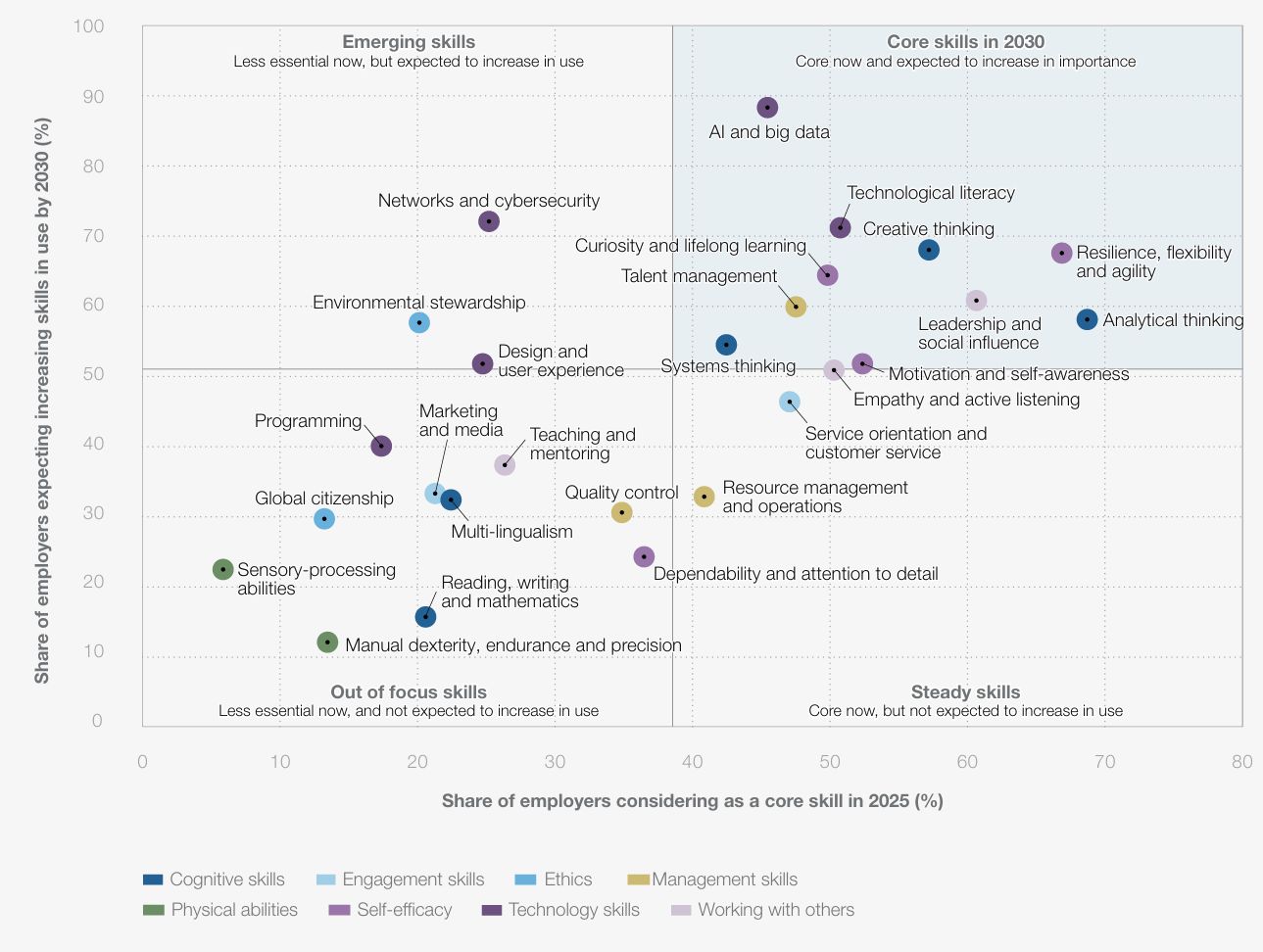
A look at the competence matrix of the future (see WEF graphic) shows: The so-called 'Core Skills 2030' are characterised by psychological demands. Creative thinking, resilience, self-confidence, empathy, motivation, social influence; all these are not technical but mental skills.
What initially sounds like humanism in the age of digitalisation reveals, upon closer examination, a quiet paradox: The future core competencies are intra-psychic - but the understanding of them remains superficial.
Psychological skills as the new currency
More than 60% of employers expect that skills like resilience, self-confidence or creativity will become even more important. But where do these skills actually come from? And why are they suddenly so central?
The answer lies within: In the mental economy of the individual. Those who need to react flexibly require emotional regulation ability. Those who are to lead with empathy need access to themselves.
These competencies are not tools; they are inner states, whose development is deeply rooted in self-perception, memory, imagination, and self-control.
The quiet crisis behind the skill hype
The problem: Companies talk about skills, but not about the psychological prerequisites that enable them. They expect flexibility without creating emotional security. They demand creativity but do not create inner calm. They wish for resilience without taking collective exhaustion potential seriously.
This is where the model of inner economy applies: The mind is a dynamic resource system - emotions and memories act like economic goods. Those who are overloaded internally have no capacity for innovation. Those who are mentally fragmented lose the ability to self-regulate.
From skills to inner work
- Analytical thinking requires clarity, hence mental relief.
- Self-confidence emerges through the conscious integration of memory and identity.
- Empathy requires imaginative competence.
- Motivation is a result of meaningful connection, not of bonus models.
The true transformation is introspective
If future work is supported by psychological skills, then we need not more training but more mental infrastructure: spaces for self-reflection, collective memory, emotional regulation.
Those who want to invest in the future must take the inner economy of humans seriously.
The question is not: What skills do we need?
But: What inner conditions make them possible in the first place?
Next Post