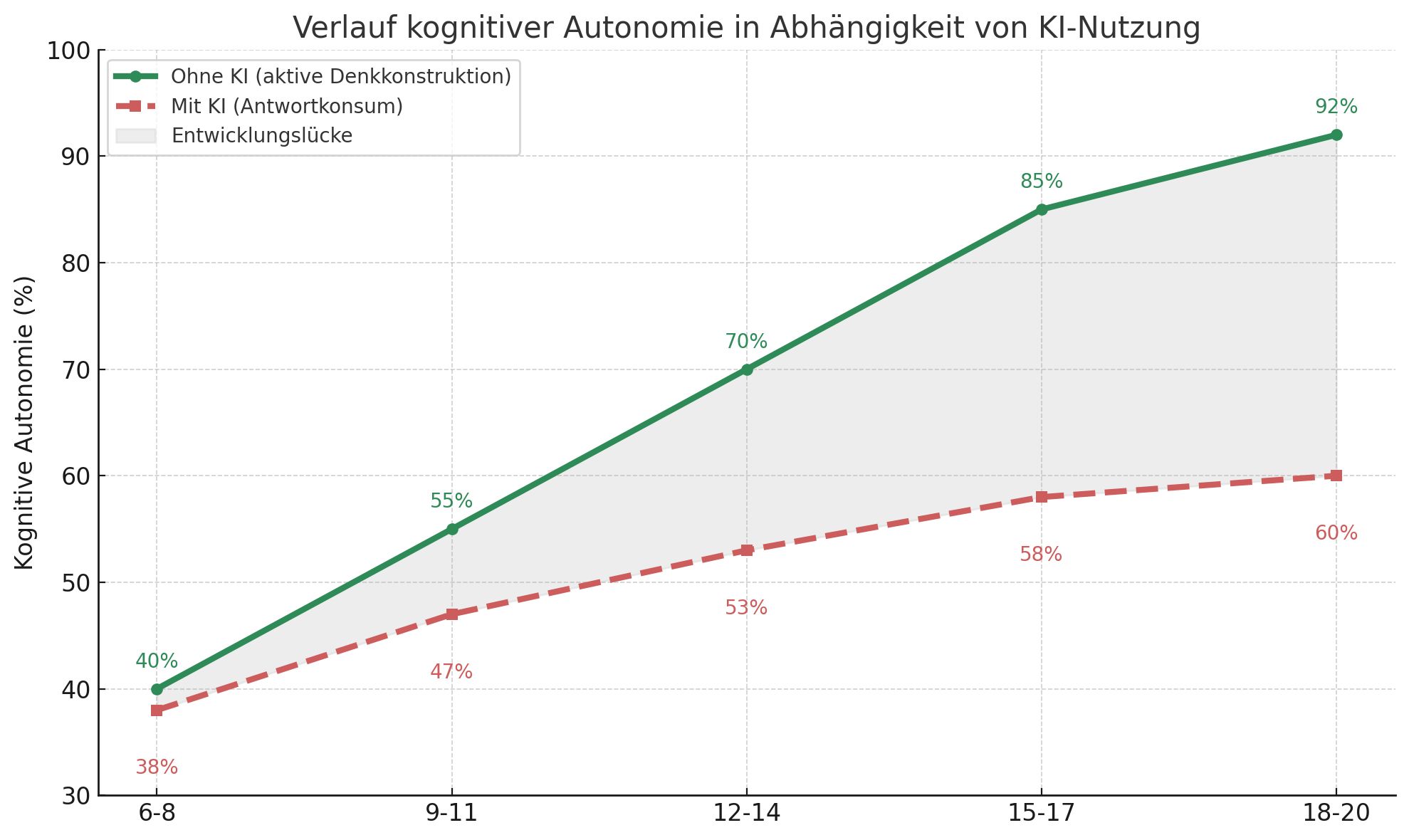
In the current education debate, Artificial Intelligence (AI) is often hailed as a revolutionary tool for promoting individual learning processes. Adaptive systems are supposed to help children and adolescents learn more efficiently and with greater motivation. However, these hopes overlook a fundamental psychological assumption: cognitive competence does not arise from access to answers, but from 𝐭𝐡𝐢𝐧𝐤𝐢𝐧𝐠 𝐚𝐜𝐭𝐢𝐯𝐢𝐭𝐲.
Children and adolescents are in a crucial phase of cognitive development. Psychology describes how executive functions, working memory, problem-solving ability, and metacognitive control only develop through active engagement with cognitive challenges. The acquisition of thinking skills is not a passive transfer process, but a construction process through errors, doubts, detours, and cognitive effort.
This is precisely where AI potentially acts dysfunctionally. Studies show that AI-supported tools like ChatGPT are used particularly when the effort of thinking wants to be avoided. The illusion of understanding through consumed answers does not replace the constructive process of thinking, but undermines it. In a meta-analysis on the learning effectiveness of generative AI, there were positive effects on short-term learning outcomes – however, there was a lack of data on the long-term development of cognitive autonomy. Critically, children become accustomed to not thinking through questions themselves, but to retrieving automated answers. The consequence is 𝐭𝐡𝐞 𝐞𝐱𝐭𝐞𝐫𝐧𝐚𝐥𝐢𝐬𝐚𝐭𝐢𝐨𝐧 𝐨𝐟 𝐭𝐡𝐢𝐧𝐤𝐢𝐧𝐠 and with it a weakening of self-efficacy and thinking identity.
Additionally, AI cannot convey semantic depth, but merely imitates pattern recognition. The building of conceptual structures (a central goal of school education) falls behind when answers are only syntactically coherent, but not epistemically elaborate. Especially with children, there is a risk that they cannot distinguish between true understanding and convincing simulation. This not only carries the risk of misconceptions but also reinforces an epistemic nihilism: when all answers are equally readily available, the search for truth loses relevance.
AI can support learning processes - but not replace them. In the sensitive phase of children's and adolescents' development, the use of generative systems can promote cognitive inertia, undermine self-regulation, and externalise thinking processes. Cognitive competence grows through irritation, exploration, and personal activity - not through the consumption of pre-formulated answers.
Educational policy and pedagogical practice must therefore develop and apply well-founded concepts before a grand tool becomes a mental crutch.
Next Post